








2026 FIFA World Cup Rule Changes Explained: New VAR, Anti-Time-Wasting Laws and Red Card Rules
For decades, football fans have accepted one frustrating reality: the beautiful game has often been slowed down by ugly tactics. Whether it was players exaggerating injuries, goalkeepers wasting precious seconds over every goal kick, or substitutes taking an eternity to leave the pitch, football developed a culture where gamesmanship was often rewarded instead of punished. That culture may finally be coming to an end.
Ahead of the 2026 FIFA World Cup in the United States, Canada, and Mexico, football lawmakers have approved a series of significant rule changes designed to speed up matches, protect fair play, and improve the experience for supporters.
And make no mistake: these are not minor tweaks.
These are some of the most aggressive anti-time-wasting measures football has seen in decades.
Five-Second Countdown Could End Time-Wasting Tactics
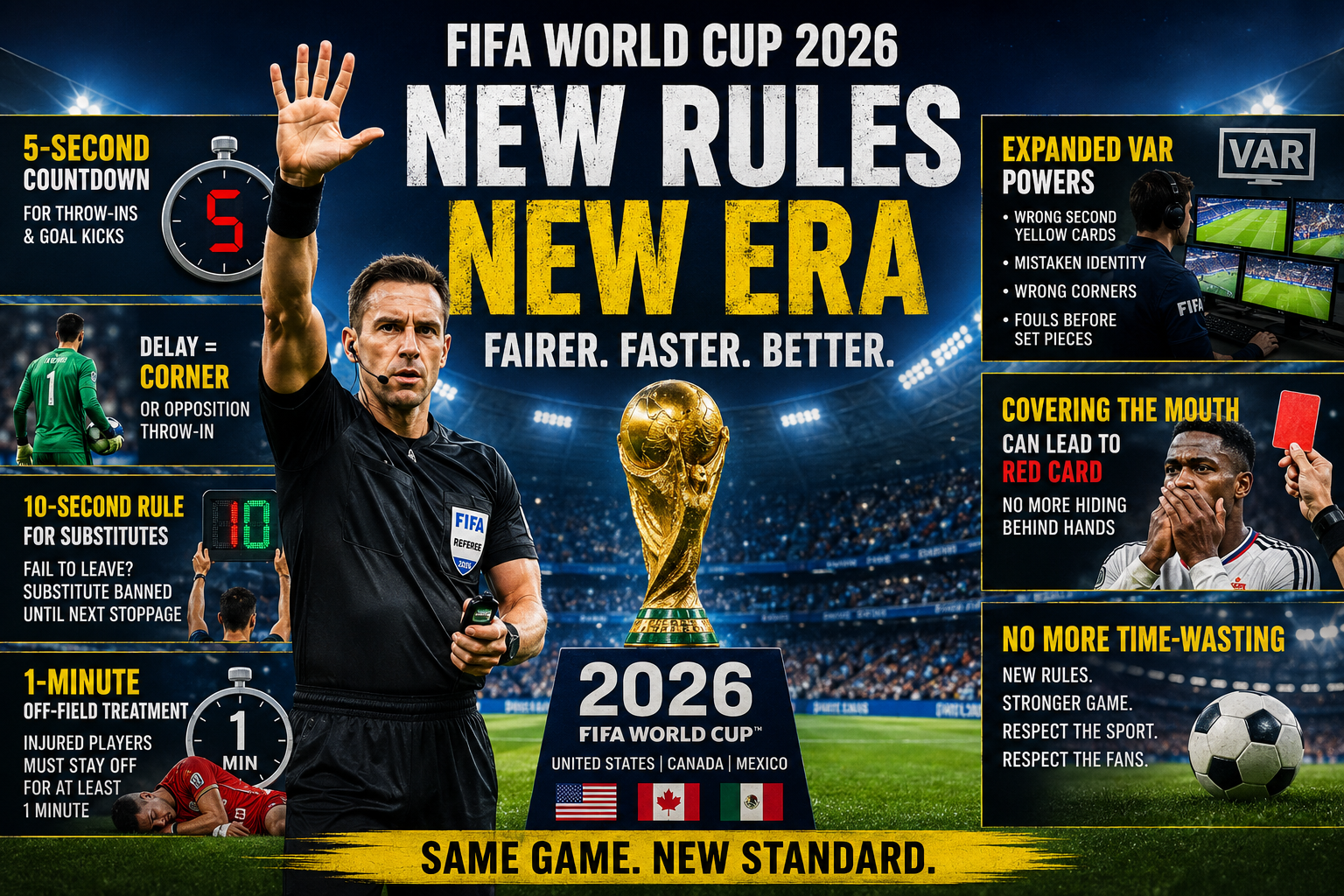
Perhaps the most eye-catching change is the introduction of a visible five-second countdown for throw-ins and goal kicks.
Under the new law, referees can begin a visual countdown whenever they believe a player is deliberately delaying the restart of play.
The consequences are severe.
If a throw-in is not taken before the countdown expires, possession is awarded to the opposition. If a goalkeeper delays a goal kick beyond the countdown, the opposing team is awarded a corner kick.
That single rule could dramatically alter how teams approach the closing stages of matches.
Managers who previously instructed players to slow the game down may now think twice when every wasted second carries a genuine competitive risk.
For supporters who have spent years watching goalkeepers take 30 seconds to place a ball for a goal kick, this change is likely to be welcomed.
The End of Slow Substitutions
Another major reform targets one of football’s oldest tricks.
Players being substituted will now have just 10 seconds to leave the field once the substitution board is displayed. They must also exit using the nearest boundary line.
Failure to comply comes with a unique punishment.
The incoming substitute cannot enter the pitch until the next stoppage after at least one minute of play has passed.
This effectively leaves the offending team playing with ten men temporarily.
The rule is specifically designed to discourage players from deliberately slowing the game when their team is protecting a lead.
Fake Injuries Could Become Much Less Attractive
Football’s relationship with injury stoppages has long been controversial.
Many fans have watched players receive treatment, only to immediately sprint around moments later.
The new off-field treatment rule aims to reduce that behaviour.
If an outfield player receives treatment on the pitch, they must remain off the field for at least one minute after play restarts, except in specific situations such as head injuries, goalkeeper incidents, serious collisions, or penalty situations.
The logic is straightforward.
If players know that stopping play for treatment will leave their team temporarily short-handed, there is less incentive to exaggerate minor knocks for tactical purposes.
Expanded VAR Powers Could Improve Decision-Making
Video Assistant Referee technology remains one of football’s most debated innovations.
However, FIFA and IFAB have decided that VAR should play a larger role at the 2026 World Cup.
Officials will now be able to intervene in cases involving:
- Clearly incorrect second yellow cards
- Mistaken identity
- Incorrectly awarded corner kicks
- Certain fouls occurring before set-piece restarts
Importantly, VAR will not create second yellow cards that were not originally shown by the referee.
Instead, the focus is on correcting obvious mistakes rather than expanding the system unnecessarily.
This approach may help strike a better balance between accuracy and maintaining the flow of the game.
Tougher Action Against Abuse and Misconduct
One of the most talked-about changes involves players covering their mouths during confrontational incidents.
Under the new framework, such behaviour can now result in a red card in specific circumstances, particularly where it is associated with abusive or discriminatory conduct.
The change follows growing concerns that players have used mouth-covering to conceal offensive language from cameras and officials.
Football authorities appear determined to send a clear message that abusive behaviour will not be hidden behind gestures or technicalities.
Why These Changes Matter for the 2026 World Cup
The 2026 FIFA World Cup will be the largest in history, featuring 48 teams across three host nations.
With more matches, more pressure, and greater global attention than ever before, FIFA faces a challenge: ensuring games remain entertaining, fair, and free from excessive gamesmanship.
These new laws suggest football’s governing bodies are finally willing to tackle long-standing issues rather than simply acknowledge them.
Will these changes completely eliminate time-wasting?
Probably not.
Football has always been a sport where players and coaches search for every possible advantage.
But these rules significantly raise the cost of cynical behaviour.
For the first time in years, teams that deliberately waste time may actually be helping their opponents.
And for millions of supporters around the world, that could be the most important victory of all.



Post Comment